Visitor sign in, sign out and Express QR code sign in
Visitor sign in, sign out and Express QR code sign in
Plus pre-registration, Express sign-in and visitor badges
Visitor sign-in lets you register every visitor who arrives at your station. You can build your own form with custom questions, have visitors read and sign PDFs such as NDAs, display an online form through an iFrame, take a selfie or a photo of the visitor’s ID, and print a visitor badge.
Once the form is completed, the station notifies the host by video call, phone call, SMS or email, depending on your configuration.
Visitors can also be invited ahead of time, from the dashboard or directly from a Microsoft Outlook or Google Calendar meeting. They pre-register on their own computer or phone, then use Express sign-in at the station by scanning a QR code or entering a 4-digit code. The badge prints automatically and the host is notified, exactly as if the visitor had filled in the form at the station.
Create a visitor sign-in form
- In the main menu, click Visitor sign-in.
- Click Add form.
- Complete the form’s five tabs: Name, Notifications, Sign-in form, Options and Pre-registration. Each tab is described below.
To edit an existing form, click the pencil icon next to it. Use Duplicate form to start a new form from a copy of an existing one.
The Visitor sign-in page lists your forms with a search field and a Sort by menu. Forms are listed by Name (A-Z) by default. You can also choose Name (Z-A), Date added (newest) or Date added (oldest), and your browser remembers your choice. The cards at the top show your sign-ins over the last 30 days and this week, your most used form and your busiest location.
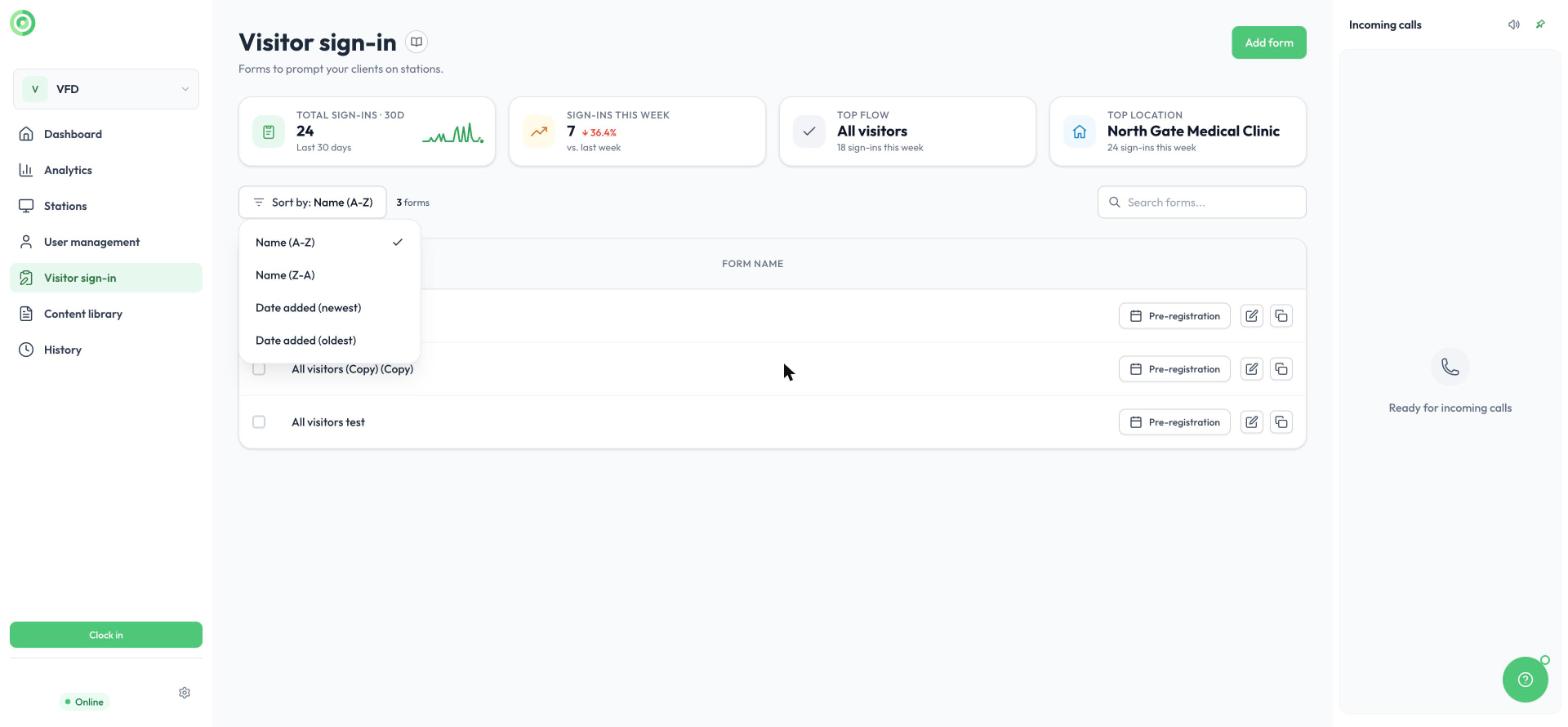
The Visitor sign-in page and the Sort by menu
Add the form to a station button
A form appears on a station only once it is linked to a button:
- In the main menu, click Stations, open the station, and go to the Buttons tab.
- Add or edit a button, and under Button action, select Visitor sign-in.
- Choose your sign-in form and click Save changes.
To learn more about buttons, read Creating Stations.
Name
Choose a name for your sign-in form. The name helps you identify and select the right form when you set up a station button.
Notifications
This tab controls what happens after a visitor signs in.
- Email a copy to the visitor after sign-in: sends the visitor a confirmation email.
- Send a notification to host after sign in: notifies the person the visitor came to see.
- Start a video call after sign-in: calls the host by video as soon as the visitor signs in. When turned off, the host receives only SMS or email notifications.
- Select between groups or users: choose whether visitors pick an individual user or a group.
- Unselect users to hide from the list: choose which users visitors can select as their host.
Tip: If only one host is offered (one user or one group), visitors are not asked to choose a host. As soon as they complete the sign-in form, the station contacts that host directly.
Groups in List mode: if visitors pick a group, or the form always contacts a group, and that group uses the List call mode, the station shows the people in the group after sign-in and the visitor chooses the person they are visiting. Only that person is called or notified. To learn more, read Groups and call queue.
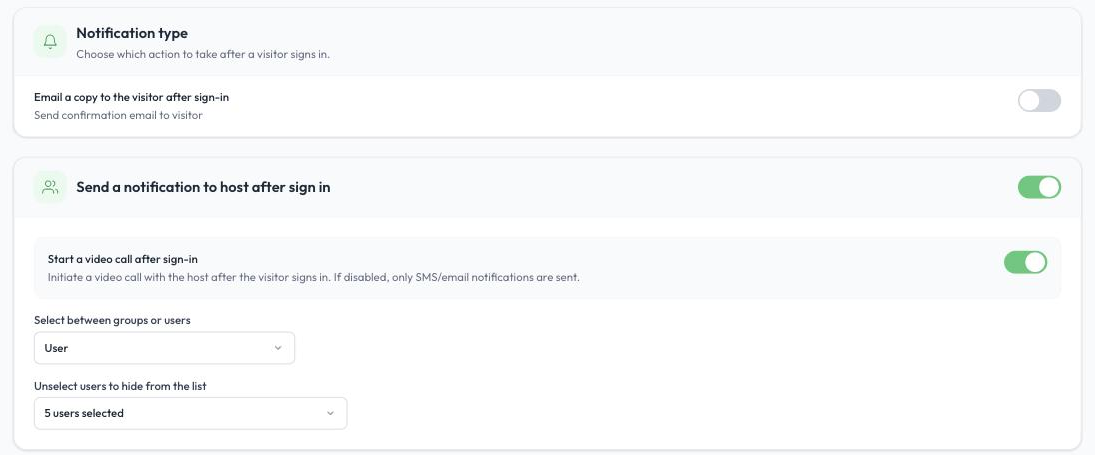
The Notifications tab
Whether each host is notified by SMS, email, phone call or video call depends on that user’s own notification settings.
Microsoft Teams users: SMS and email notifications are not available for users who receive calls in Microsoft Teams. Microsoft Teams users who belong to a group must use the Virtual Front Desk call queue associated with that group. As an alternative for group calling, you can select a Microsoft Teams call queue or auto attendant created in the Teams admin center. Import it as a standard Azure user and turn on the MS Teams Call Queue toggle so Virtual Front Desk treats it as a call queue rather than a regular user. To learn more, read MS Teams integration for video calls, call queue & auto attendant.
Sign-in form
Add fields
Build the form by adding the fields visitors must fill in. Full name is always included and is mandatory. Click Add field to add more, choose each field’s type, give it a name, and choose whether it is required. Drag the handles or use the arrows to change the order.
Some fields may be required by the options you turn on. For example, sending a sign-in summary to the visitor requires an email field, and emergency messages require a mobile number field.
Documents / iFrame
Turn on Documents / iFrame to add a document or an online form to the sign-in process, then choose the content type:
- Document (PDF): choose a PDF from your Content library, or click Upload document. Turn on Requires signature if visitors must sign it, for example for an NDA.
- Custom content (iframe): display a web page or an online form, such as a Jotform or Google Form, directly on the station. The online form must allow iFrame embedding. To learn more, read Documents, PDFs, QR Codes & iFrames.
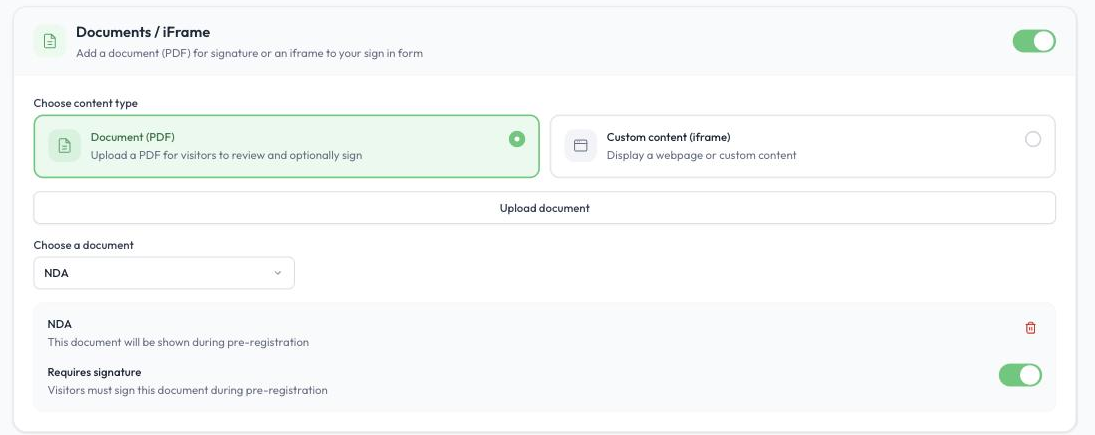
The Documents / iFrame section of the sign-in form
Sign-in message
Personalize the message displayed to visitors after they sign in, and choose how long it stays on screen (between 1 and 30 seconds).
Options
The Options tab lets you turn on advanced features to complete the sign-in experience.
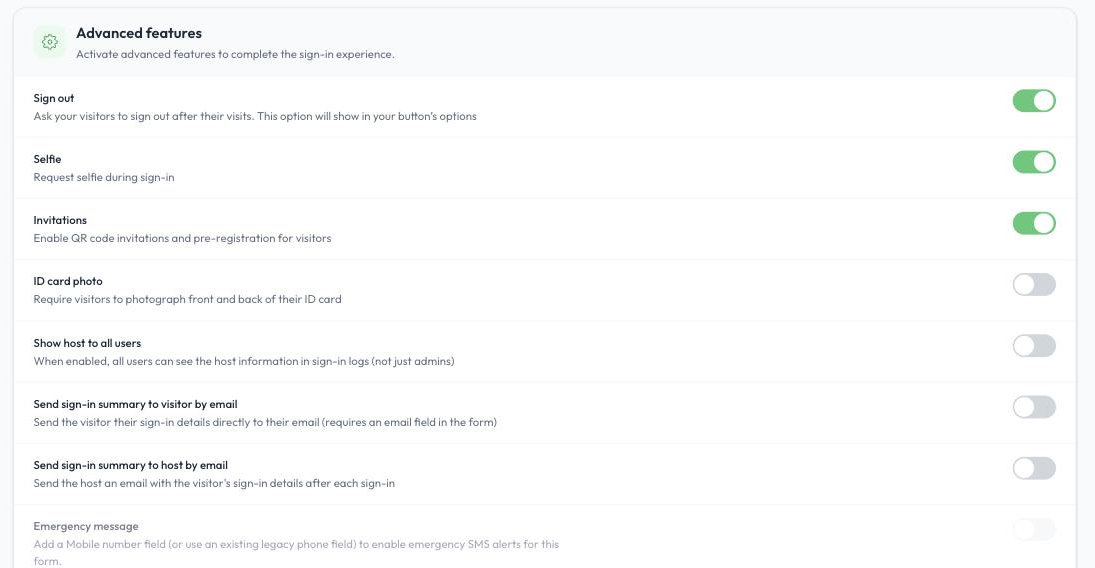
The Options tab
- Sign out: asks visitors to sign out when they leave. Once turned on, Sign out becomes available as a button action on your stations. See Visitor sign-out below.
- Selfie: asks visitors to take a selfie during sign-in. The selfie can be printed on the visitor badge and is saved in your sign-in logs.
- Pre-registration: enables pre-registration and QR code invitations. See Pre-registration and Express sign-in below.
- ID card photo: asks visitors to photograph the front and back of their ID card.
- Show host to all users: lets all users, not only administrators, see the host information in the sign-in logs.
- Send sign-in summary to visitor by email: sends visitors their sign-in details by email. The form must include an email field.
- Send sign-in summary to host by email: sends the host an email with the visitor’s sign-in details after each sign-in.
- Emergency message: enables emergency SMS alerts to visitors who signed in with this form. The form must include a mobile number field. Emergency Message
- Visitor badge (printer needed): prints a badge after each sign-in. See Visitor badge below.
Visitor sign-out
When Sign out is turned on, add a sign-out button to your station:
- Open the station’s Buttons tab and add or edit a button.
- Under Button action, select Sign out and choose the sign-in form it applies to.
- Click Save changes.
When leaving, visitors press the button, enter the first letter of their name, select their name from the list and confirm. You can see who signed in and out, with the information they provided, under History > Sign-in logs. To learn more, read History: Call logs, Other actions, Sign-in logs, Pre-registration logs, Transaction logs and AI conversations.
Visitor badge
Turn on Visitor badge (printer needed) to print a badge each time a visitor signs in. You can set:
- Header text: the title printed at the top of the badge, such as “Visitor”.
- Selected fields: the form fields printed on the badge. Choose a field and click Add field.
- Custom footer text: an optional line at the bottom of the badge.
- Company logo: your logo, in a 1:1 or 2:1 ratio.
- Badge options: add the visitor’s selfie, and show the date and time.
The Badge preview updates as you make changes. Click Test print badge to print a sample.
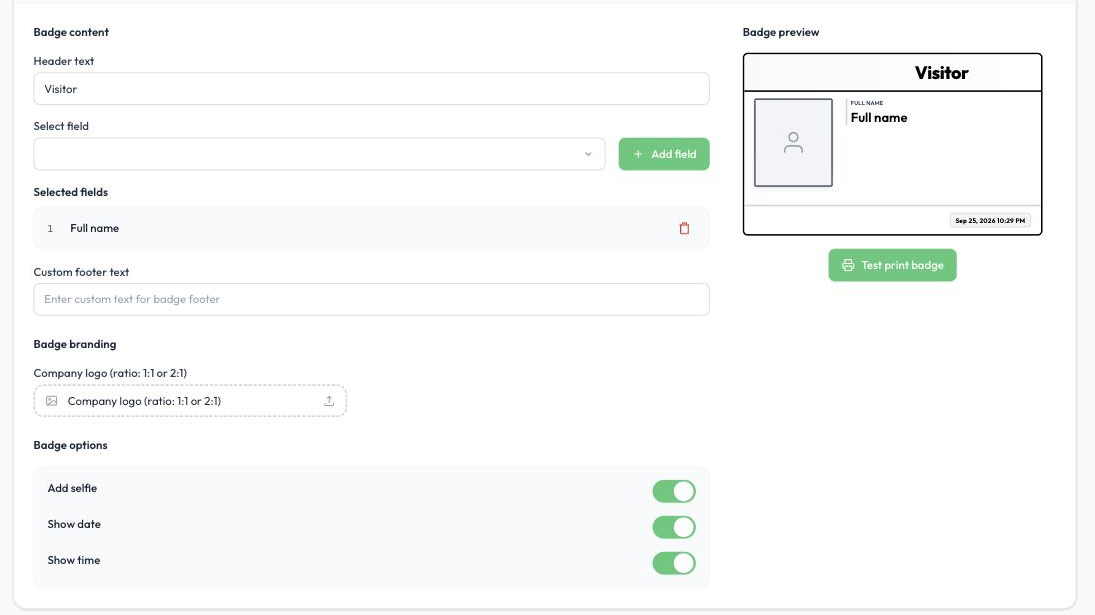
Visitor badge settings and preview
To set up your label printer, read Printer, Printing Badges and Documents.
Pre-registration and Express sign-in
With Pre-registration turned on, you can invite visitors before they arrive. They fill in the sign-in form on their own computer or phone, then check in at the station in seconds with Express sign-in.
Send an invitation
- Open your form and go to the Pre-registration tab.
- Click New invitation.
- Select the Location and the Host, and enter the Visitor name.
- Choose the Invitation method: Email, SMS or Both, and enter the visitor’s email address, phone number, or both.
- Enter the Visit date and, optionally, the visit start and end times and a custom message.
- Click Send invitation.
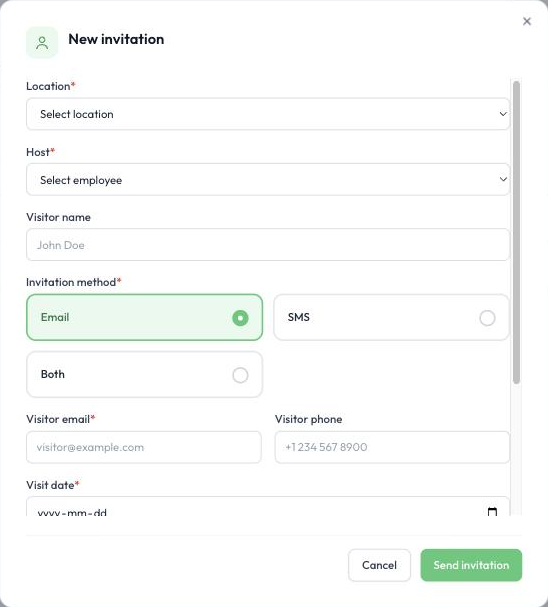
Creating a new invitation
To invite several visitors at once, click Bulk invitations.
The visitor receives the invitation with simple step-by-step instructions to pre-register.
Send pre-registrations from Microsoft Outlook
With the Virtual Front Desk for Outlook add-in, hosts can send pre-registrations directly from their Outlook calendar while they create a meeting, without signing in to the Virtual Front Desk dashboard.
Install the add-in (administrator, one time):
- In the Microsoft 365 admin center, go to Settings > Integrated apps > Get apps.
- Search for Virtual Front Desk for Outlook and install it.
- Assign the users who can use it and choose the deployment method.
Send a pre-registration from a meeting:
- In Outlook, create a new meeting, add your guests and complete the meeting details.
- Click Virtual Front Desk for Outlook at the top right of the meeting window.
- Select the meeting location, the host (from your Virtual Front Desk users) and the sign-in form to fill in. External attendees are selected automatically, and you can also select internal attendees if needed.
- Click Send Pre-Registrations. Your guests immediately receive an email with a link to complete the sign-in form.
- Send your Outlook meeting invitation as usual so the meeting is added to everyone’s calendar.
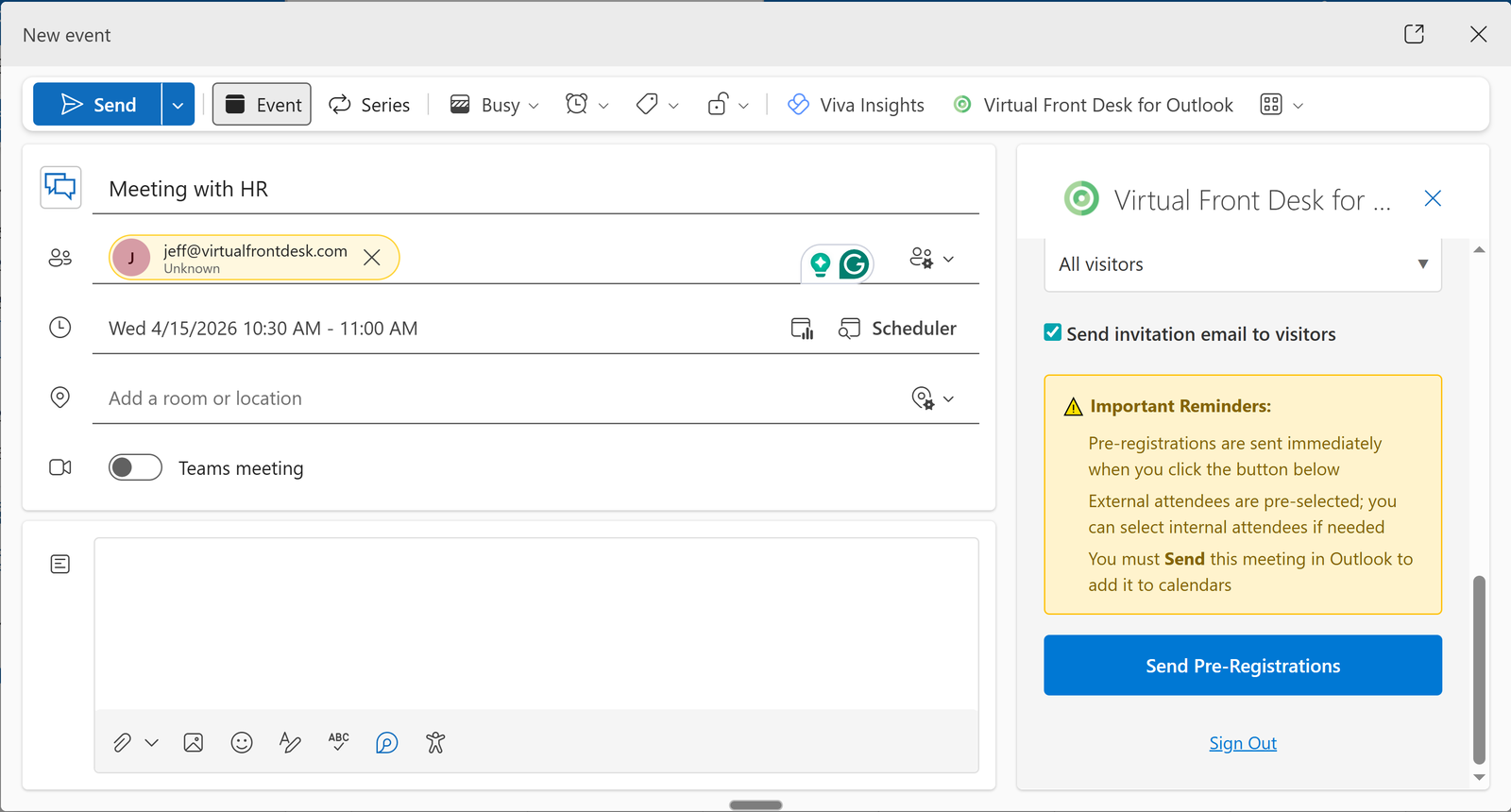
The Virtual Front Desk for Outlook add-in in a new meeting
The add-in then shows the status of each pre-registration, with the option to delete it. Click View dashboard to open Virtual Front Desk, signing in with Microsoft SSO and the same email address.
Note: The add-in is available in the Outlook calendar only. It is not available from the Microsoft Teams calendar.
To learn more, read Outlook Calendar add-in for Pre-Registration and Express QR code Sign in.
Send pre-registrations from Google Calendar
With the Virtual Front Desk for Google Calendar add-on, hosts can send pre-registrations from a saved Google Calendar event in the same way, without signing in to the Virtual Front Desk dashboard. The add-on is available on every plan.
To learn more, read Google Calendar add-on for Pre-Registration and Express QR code Sign-in.
Express sign-in at the station
When they arrive, pre-registered visitors scan their QR code at the station or enter their 4-digit code. The badge prints automatically and the host is notified, exactly as if the visitor had completed the form on the station.
Track your pre-registrations
The Pre-registration tab lists every invitation with the visitor’s email, name, visit date and status:
- Pending: the invitation was sent, but the visitor has not filled in the form yet.
- Pre-Registered: the visitor filled in the form before arriving.
- Completed: the visitor arrived and checked in at the station.
Click Resend invite to send an invitation again, or the eye icon to view its details. Click Refresh to update the statuses.
All pre-registration activity is also recorded under History > Pre-registration logs, and every visitor who signs in is saved under History > Sign-in logs.